

Busy
GTM or GTFO | Being Busy vs. Being Useful

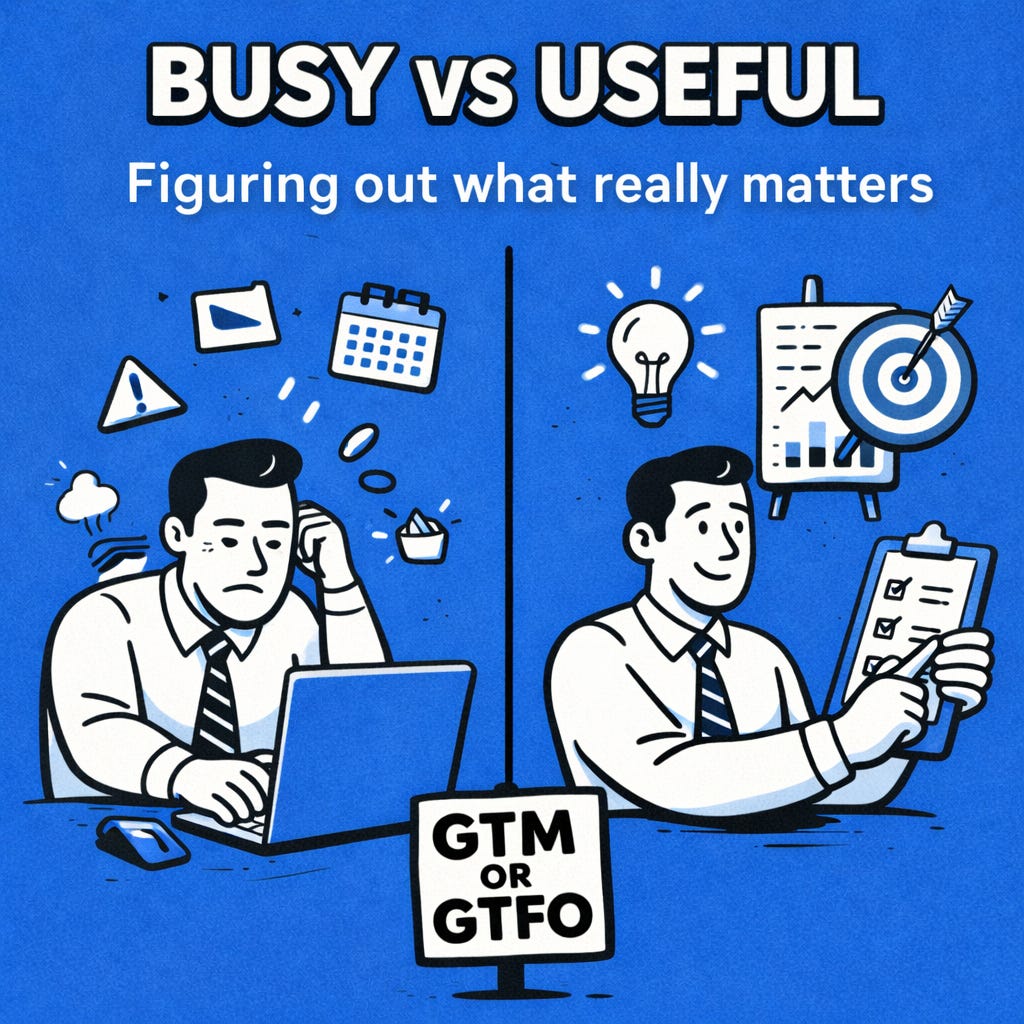
For a long time, I confused movement with progress.
I know I am not alone in this.
In GTM roles especially, busyness is often mistaken for value. The louder your calendar, the busier you are, the more important you must be. The faster you respond, the more committed you look.
But being busy is not the same thing as being useful.
I got this wrong.
This was something I struggled with deeply in my corporate years and something I still have to actively fight as a CRO and as an independent operator.
In my corporate years we actually got rewarded for “working hard”. The incentives push you toward activity. More meetings felt productive. Staying late meant you were thought of as a rising star. What a load of crock!
When I look back at my best work, it never came from being stretched thin. It came from focus. It came from choosing a small number of things that actually moved the business forward and ignoring a lot of noise that was surface-level important.
The difference between Busy Work and Useful Work sounds subtle, but it is not.
Busy work:
Reactive
Driven by whatever is loudest or newest
Focused on inputs like meetings, messages, and tasks
Designed to fill time and signal effort
Useful work:
Intentional
Anchored to outcomes, not activity
Focused on leverage and second order effects
Designed to change behavior, decisions, or results
If you are a full-time GTM operator you know what I am talking about. For those of you who might be a Fractional Executive or Independent Operator, this difference becomes impossible to ignore.
You do not own the full calendar. You are not there to attend everything. You are there to help them improve in a particular area.
If I spend my very limited time sitting in meetings that do not alter decisions, behavior, or outcomes, I am failing the engagement even if I look present and look “engaged.”
At the end of each week, I started asking one question: What would not have happened if I were not here?
This is a GREAT question to ask yourself in ANY role. It is a classic “Butterfly Effect” question, often used as a prompt for self-reflection or to acknowledge your unique impact on the world.
This question is about causality. Every action you take, no matter how small, shifts the timeline of the people around you. It’s also a question about legacy in the moment.
If I can’t answer the question there is a problem.
Asking myself the question, regularly forced to refocus my time and energy.
Refocusing was hard and uncomfortable. It meant trading visibility for a better focus on outcomes. That meant saying no more often and meant disappointing people who wanted access.
A few changes that help me stay grounded.
Anchor the week to outcomes - I now start each week with a small number of outcomes that matter. Not a task list. If a meeting or request does not connect directly to one of those outcomes = gone.
I passionately protect deep - Useful work requires focus, thinking, writing, modelling, or reviewing data without interruption. I block time for it and it is non negotiable.
I prioritize second order impact - This is work that reshapes the rest. Some examples of this are; a clear ICP definition that aligns everything, an A player hire that helps to change momentum, or a tough conversation with a founder that ensures we are on the same page. These are all things that rarely feel urgent. but are always useful.
I still catch myself slipping. I still have weeks where my calendar wins and my focus loses but I am getting better at noticing it earlier and correcting faster.
Being busy is easy. Being useful takes discipline.
🔧 GTM Tools I’m Using
I work with many different GTM tools. Some have become partners. Some aren’t.
Any tool I mention here is because I’ve actually tested it with clients or in my own workflow (also, loving the people behind the tool is mandatory).
I work with many different GTM tools. Some have become partners. Some aren’t. Here are some of the GTM tools I am using...
Any tool I mention here is because I’ve actually tested it with clients or in my own workflow
also, loving the people behind the tool is mandatory
Every once in a while, I share a list of tools I’m actively using with clients or testing myself.
Here’s a list of some of my GTM tools that I am using/testing (or a fanboy of)
Reevo - ai native CRM with advanced capabilities, using with a client
Aligned - use daily in my business
POD - advisor and huge fan of this deal intelligence tool sales teams need
Avarra - ai sims, real-time coaching - playing with this every day
FullEnrich - search, enrichment, data i need to power any GTM
Hubspot - still using for various clients
Quibbly - for LinkedIn video and voice notes
Slack - daily comms with clients, partners, vendors
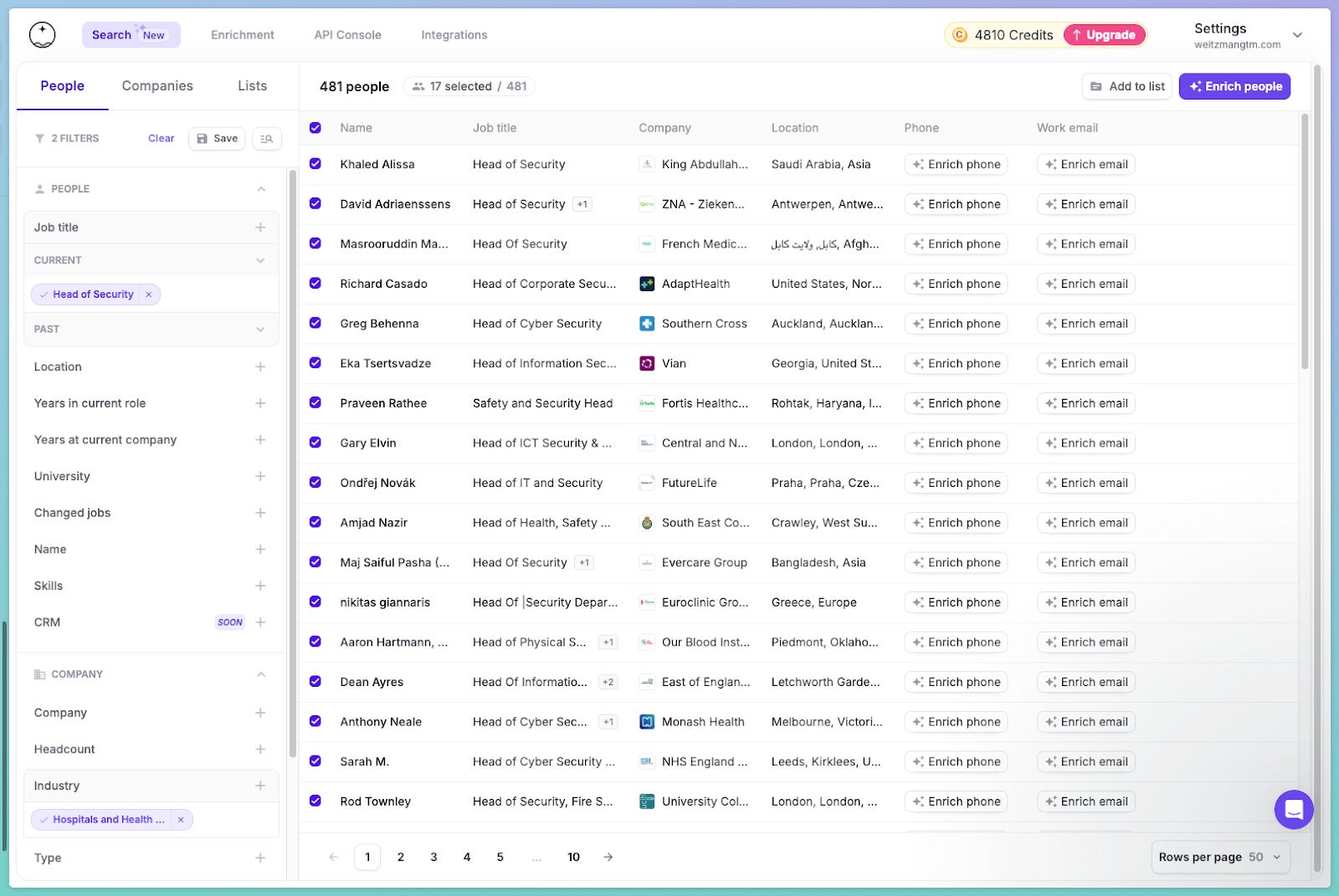
I’m going to go a little deeper on FullEnrich as they just launched a new Search capability that got me excited - here: https://fullenrich.com/search
As a CRO, this is how I pressure test whether an outbound plan is even real.
Before messaging, sequencing, and that 1 hour meeting arguing over the copy I answer one question:
Can we actually find and reach the people we’re betting the quarter on?
I’ve been doing some list building for a few different clients lately and I’m always trying different tools.
The best copy and research in the world fails if you aren’t sending it to the right person at the right time. So, if I can’t build a list confidently (which means accurately and quickly) the outbound plan has a BIG crack in it.
I decided to have some fun and try to break it. I started pushing it by looking for some kind of niche personas - ones that are harder to find.
Head of Security at hospital and healthcare companies
VP Ops at logistics firms.
Farmers and ranch managers
Foreman at midsized construction firms
Owner/operator at logistics and trucking companies
These are the kinds of roles that usually turn into ghost hunts. Not this time, I found 481 heads of security at hospitals & healthcare companies.
When I evaluate a prospecting system I think about it as a CRO. So, I’m not asking if it makes clicking buttons easier. I’m asking if it makes revenue more predictable.
Here’s what I look for;
Coverage across org charts
Enrichment accuracy
Ease of rerunning searches
Speed of list building
Can this scale without turning into a Data Frankenstein 🧟♂️
Go run a free search yourself. I used it with my client the other day for the first time and the CEO said, “Yes, these are the people we are going after” and everything after got easier.
If you try it, tell me what you think.
Why GTM or GTFO Exists and Final Thought
The GTM world is full of best practices, big talkers and bullsh!t. It’s short on honesty, humbleness and transparent results.
Calendars are packed and tools are everywhere. But, most of us are still unsure what is working to move revenue forward one month to the next.
GTM or GTFO exists to provide some real learnings, real lessons and and a hopefully some real smiles.
Do the work that matters. Or GTFO.
Thanks for reading. Know a seller stuck on average?
Forward this issue and help them level up.