

Bullsh!t
GTM or GTFO | Why “Best Practices” Are Usually Bullsh!t and Just Survivor Bias

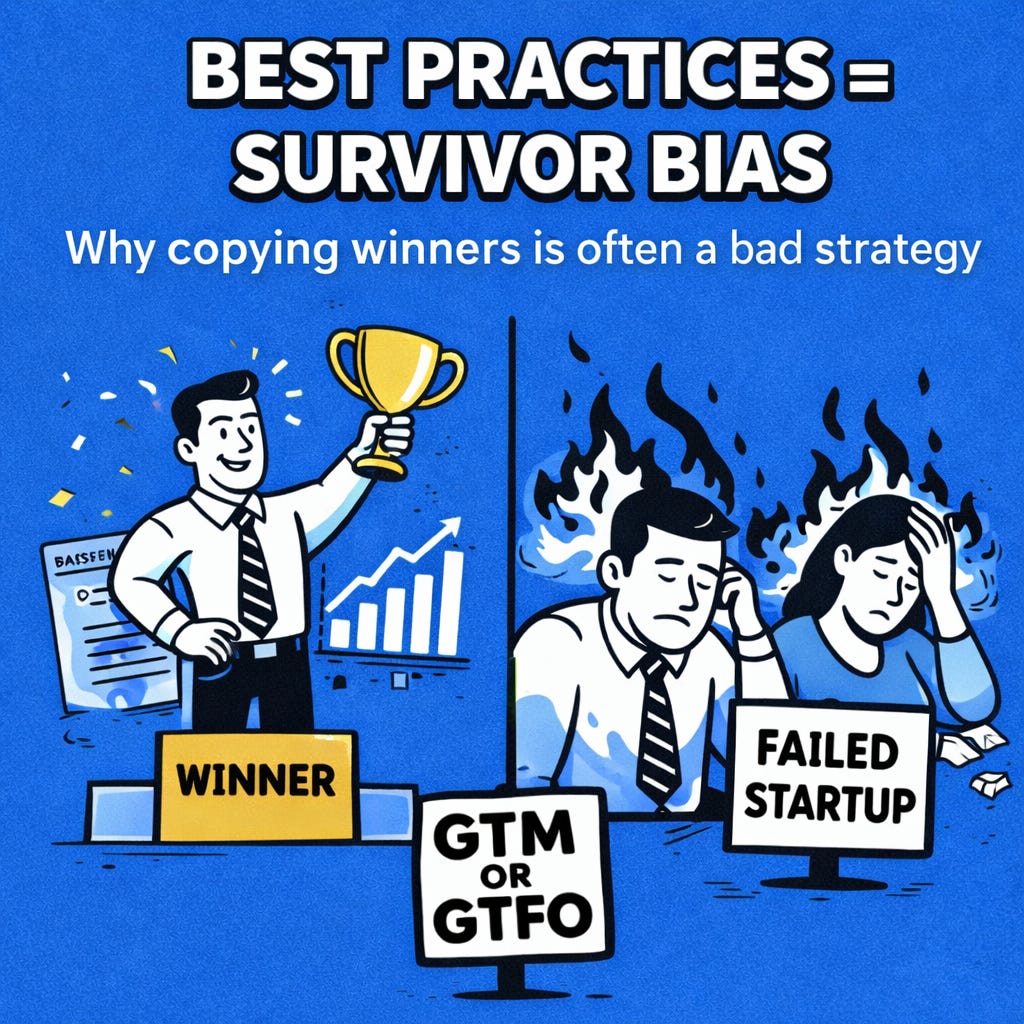
“Best Practices”
Every deck has them. Every advisor references them. Every CEO asks for them and every damn LinkedIn post seems to know exactly what YOU should do for untold riches.
“Best practices”
They sound safe but most of the time they quietly kill more progress than almost anything else in GTM.
I used to chase them and I often still catch myself doing it.
So where do “best practices” actually come from?
Most so called best practices are reverse engineered from companies that already won or sometimes from people trying to sell you something.
We look at the winners and say:
This is how they structured their sales team
This is how often they sent emails
This is the pricing model they used
This is the motion they scaled
Then we assume those choices caused the outcome. Sometimes they did but often they did not.
We forget about the hundreds of companies that followed the same playbook and failed quietly. We forget about them for two reasons:
The people who failed are not writing blog posts, are not generally keynoting conferences and are not in your LinkedIn feed.
We want to believe it is easy.
That is survivor bias in its purest form.
There is an comfort but also extreme danger in copying.
Best practices feel good because they remove responsibility. If it does not work, you can say: “We followed the playbook.”
As a fractional CRO, I have seen this pattern everywhere.
Founders copying outbound cadences from companies with totally different ICPs
Sales teams adopting frameworks built for enterprise while selling SMB
Marketing teams mimicking content strategies that worked because the brand already had demand
The uncomfortable truth is this. What worked for them often worked because of timing, distribution, brand momentum, capital, or talent density. Not because of the tactic itself.
I learned the hard way.
Earlier in my career, I wanted certainty. So I leaned on best practices instead of judgment and over time, I noticed something uncomfortable. The more senior and effective operators I worked with rarely talked in absolutes. They asked better questions instead.
Why would this work here? Why might this not work here?
What assumptions are baked into this tactic?
What breaks if we are wrong?
What is the smallest version we can test?
They were not anti best practices. They were skeptical and asked great questions to verify and make good decisions.
There is no universal GTM motion that works. Context beats playbooks every time.
What works depends on: your buyer maturity, your price point, your sales cycle, your competitive environment, your internal capabilities, your timing, etc.
Side note: If you are a fractional leader like me, your job is not to import answers. It is to ask the right questions and to diagnose reality.
So if best practices are bullsh!t, what do we do instead?
We should 100% study what great companies do. But just treat it differently. Here is how to approach it;
Borrow principles, not tactics
Test before you scale (it should survive a small test)
Assume you are different because you are
Be honest about constraints (capital, time, talent, and brand all matter)
Trust pattern recognition over popularity (the loudest ideas are generally not the best ones)
Let’s end this section with a little game
Who has the better quote? :)
A) “Best practices are best for someone else” - Neil Weitzman
B) “High probability practices” I like to say - Kyle Norton
🔧 GTM Tools I’m Actually Using
I work with a lot of GTM tools. Some have become partners. Some aren’t.
Any tool I mention here is because I’ve actually tested it with clients or in my own workflow (also loving the people behind the tool is mandatory).
“That’s how we’ve always done it” will get people fired in 2026.
There used to be a saying that nobody ever got fired for buying IBM. That mindset made sense when stability was the priority. Today, it is one of the most dangerous sentences in GTM.
In my experience, the biggest hurdle to upgrading your revenue system is not budget. It is fear of change. It is the fear of a migration and breaking something.
We have all heard this before: “Our CRM is expensive, and my reps hate it… but moving would be a nightmare.”
Well get over it… there is no better time.
I saw a couple demos of Reevo in early 2026 and loved it. I now have a client onboarding and I am blown away.
Here’s why:
“AI-Native” vs. “AI-Bolted-On” - Reevo is AI from the ground up. 100% visibility into every email, call, and meeting without needing to “sync” or “bridge” different tools.
Elimination of sales stack tax - vertically integrated platform and tech stack all within Reevo - lead prospecting and data enrichment, multi-channel sequencing, meeting intelligence and call recording, pipeline, one login.
Better prep, follow-up and time savings - all built in
Active system (not a passive database) - Traditional CRMs are passive and only know what a sales rep manually puts in. Reevo auto logs all activity - it listens to calls, extracts action items, updates deal stages based on conversation sentiment, and creates tasks automatically.
Zero manual data entry - aims to eliminate manual entry entirely by using smarkt task logging to pull implicit and explicit tasks from conversations and then drafts follow-ups that match the rep’s voice
Clean first-party data - most CRMs get dirty over time, but Reevo generates its own first-party data directly from the emails, meetings, and calendars it hosts, the data is always clean, deduplicated, and mapped correctly to accounts.
Small enough to care what I think - The bug guys don’t care about me or you. I am one of 100,000 customers. Reevo wants my feedback and wants to improve. I get that might change in the future but I like it. I’m tried of not getting the service I deserve from the others.
Remember: Migration discomfort is a thirty day problem, while a broken GTM stack is a 10 year compounding problem.
If you check Reevo out, let me know. We can learn together.
Why GTM or GTFO Exists and Final Thought
The GTM world is full of best practices, big talkers and bullsh!t. It’s short on honesty, humbleness and transparent results.
Calendars are packed and tools are everywhere. But, most of us are still unsure what is working to move revenue forward one month to the next.
GTM or GTFO exists to provide some real learnings, real lessons and and a hopefully some real smiles. Do the work that matters. Or GTFO.
Pass this to someone you are thinking of.
Lot of wisdom in here Neil, thx for sharing. As a longtime revenue leader and also a fractional CRO for 8 clients more recently, the dangers you present are real and deadly if viewed as gospel.
I always try to listen to what a company is doing, can do and wants to do and then take pieces of my experience and try to apply them.
Thank you sir